
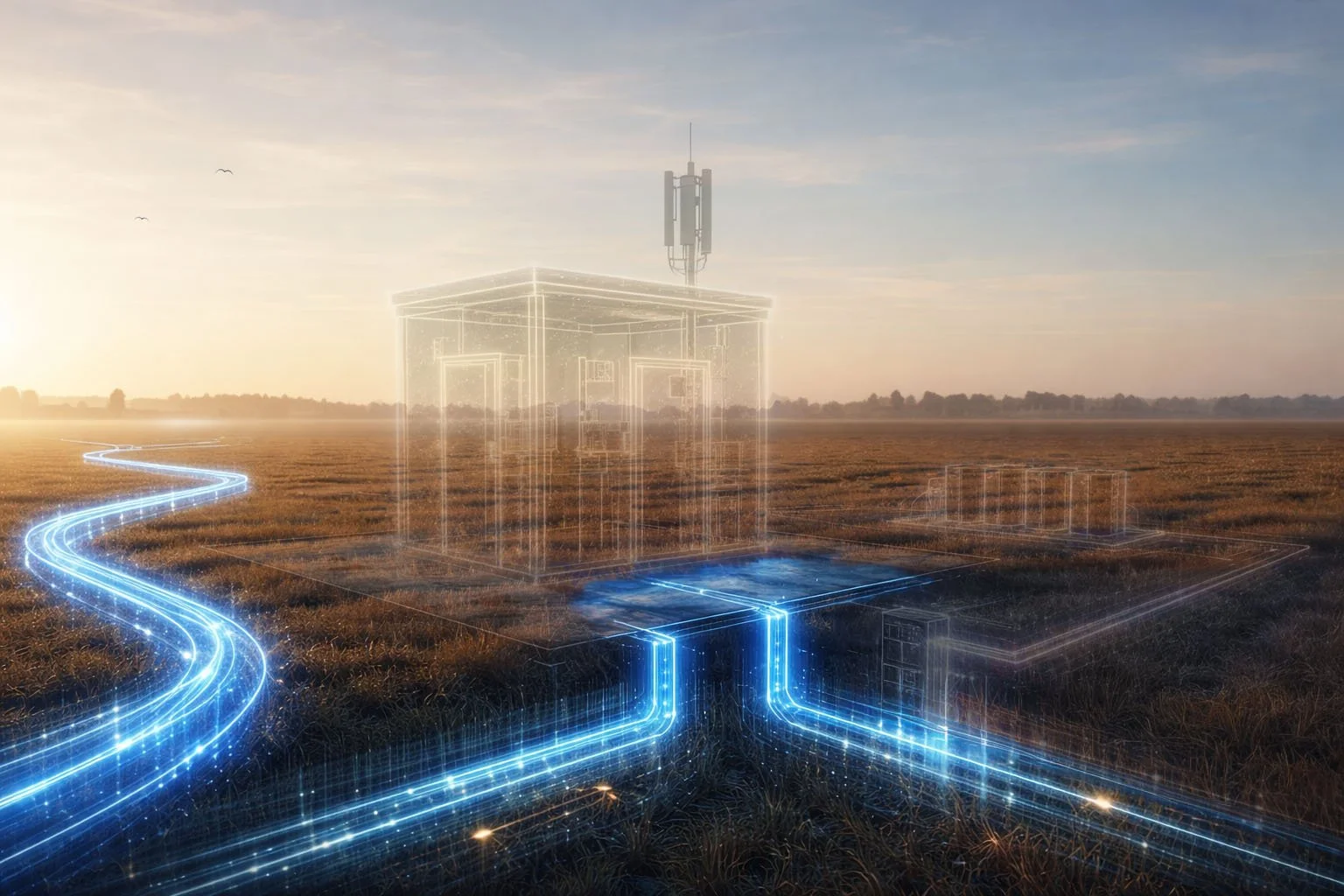
Fiber is the foundation of every long-haul network and the primary reason an ILA hut exists at all. It is the physical medium that carries massive volumes of data across vast distances, and its quality, layout, and management directly determine performance. Unlike switching or routing infrastructure, fiber works silently in the background, its success measured by what doesn’t happen: signal loss, distortion, or interruption.
In modern optical networks, fiber is engineered to remain optical from end to end. Rather than converting light to electricity and back again, signals are amplified in-line, preserving low latency and high efficiency. This allows operators to span hundreds of kilometers between terminals while supporting dense wavelength-division multiplexing (DWDM), where dozens or even hundreds of wavelengths coexist on a single pair of fibers.
The performance limits of a route are often dictated by the fiber itself. Attenuation, dispersion, reflections, and optical signal-to-noise ratio (OSNR) all influence how much capacity a span can carry and how far it can reach. As bitrates increase and modulation grows more sophisticated, tolerances tighten, making fiber quality and consistency more critical than ever.
Fiber also plays a central role in resilience and observability. Redundant paths, diverse routes, and optical supervisory channels let operators monitor performance, detect degradation, and respond before customers notice. Proper slack management, splicing, and protection inside the hut preserve these capabilities over decades of service.
As traffic driven by cloud, AI, and hyperscale workloads continues to grow, fiber is no longer just a passive asset. It is an active constraint and a strategic resource, shaping how networks are designed, upgraded, and expanded over time. The hut exists to protect, manage, and amplify that fiber without ever interrupting its optical journey.